
Tina Modotti
#HispanicHeritageMonth

Tina Modotti (1896–1942) was an Italian-born photographer, model, actress, and political activist who made significant contributions to both the arts and political movements in Mexico. Although born in Italy, Modotti’s deep connection to Mexican culture and her engagement with Latin American social and political issues position her as a key figure within Hispanic art and history. Her photographic work, which spanned from the late 1920s to the early 1930s, was marked by an intersection of aesthetic innovation and political engagement, reflecting the social upheaval of the time.
Tina Modotti was born in Udine, Italy, in 1896, into a working-class family. At the age of 16, she emigrated to the United States, joining her father in San Francisco. It was in California that Modotti began to pursue her interest in the arts. Initially, she worked as a seamstress, but she soon entered the burgeoning artistic community in Los Angeles, where she began acting in silent films and became involved with the bohemian and avant-garde circles.
Her entry into photography came through her relationship with the American photographer Edward Weston, whom she met in 1921. Weston would become her mentor and collaborator, introducing her to modernist photography and helping to refine her technical skills. Together, they moved to Mexico in 1923, a decision that would mark the beginning of Modotti’s profound engagement with Mexican culture and politics.
Mexico in the 1920s was a country in the midst of a political and cultural revolution. Following the Mexican Revolution (1910–1920), artists, intellectuals, and activists from around the world were drawn to Mexico to participate in the radical social changes taking place. For Modotti, Mexico became both her creative home and the epicenter of her political awakening. She became involved with many key figures of the Mexican Renaissance, including Diego Rivera, Frida Kahlo, and José Clemente Orozco. Modotti was also active in the Communist Party, and her political beliefs would strongly influence her photography.
Modotti’s work during this period combined a modernist aesthetic with a clear political message. Her photographs often depicted the daily lives of Mexican peasants and workers, as well as the symbols of revolutionary struggle, such as hammers, sickles, and rifles. Works like Workers’ Parade (1926) and Hands of the Peasant (1927) exemplify her ability to capture the dignity and strength of the working class through her camera. Her compositions were often stark and geometric, with a focus on form and texture, reflecting her training under Weston, but the content was deeply political, expressing her commitment to social justice and revolution.


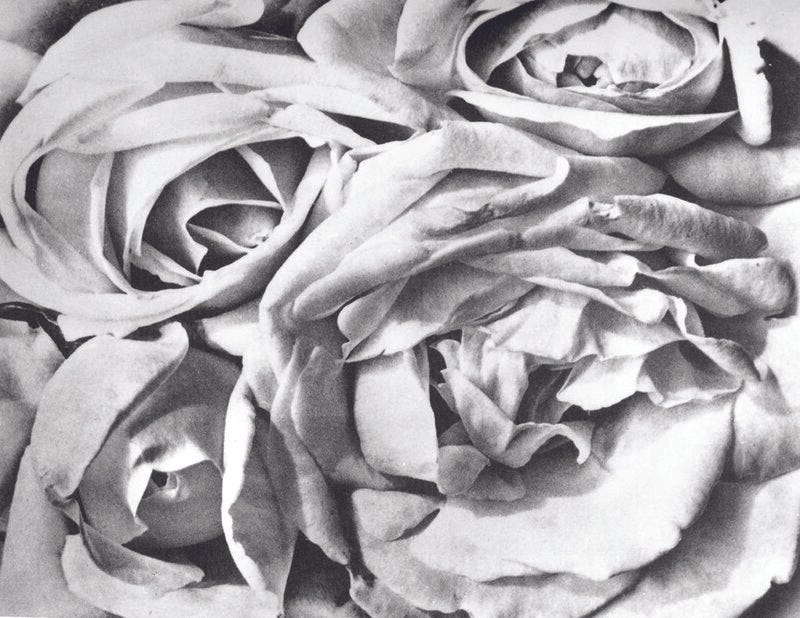
One of her most famous images, Roses (1924), captures a still life of flowers in a vase, a subject that recalls her modernist roots. Yet, even in such works, Modotti infused her subjects with a political subtext, suggesting the contrast between beauty and struggle, life and death, through the meticulous arrangement and lighting.
Modotti’s work was deeply shaped by her belief in the power of art to effect social change. She was an advocate for what she termed a “revolutionary” approach to art, rejecting the idea of art for art’s sake in favor of art that directly engaged with the political struggles of the day. In a 1929 essay, she wrote: “I cannot solve the problem of life by losing myself in the problem of art... My photography is the expression of my political sympathies.”
Her political sympathies extended beyond Mexico to the broader international leftist movements. In the early 1930s, Modotti was forced to leave Mexico due to her Communist affiliations and allegations of her involvement in political violence, although the charges were never substantiated. She spent the following years in the Soviet Union and Spain, continuing her political activism and supporting the fight against fascism during the Spanish Civil War. During this time, Modotti largely abandoned photography, focusing instead on her political activities, including working as a nurse for Republican forces in Spain.
Despite the brevity of her photographic career, Modotti’s work had a profound impact on the development of modern photography in Mexico and Latin America. Her combination of modernist formalism with political content helped to define a new role for photography as a tool of social documentation and political expression. As a Hispanic artist, Modotti’s contributions extend beyond her artistic output to her role as a cultural intermediary, bringing together the avant-garde artistic traditions of Europe and the United States with the revolutionary spirit of post-revolutionary Mexico.
Her work paved the way for later generations of Latin American photographers, including Manuel Álvarez Bravo, who continued to explore the relationship between photography, politics, and social justice. In recent years, there has been a growing recognition of Modotti’s significance as both an artist and an activist. Exhibitions and publications have highlighted her contributions to Mexican art and her role in the broader history of 20th-century photography.
Modotti’s life and work also resonate with contemporary discussions about the role of women in the arts and in revolutionary movements. As a woman working in a male-dominated field, Modotti faced numerous challenges, but she managed to carve out a space for herself as both an artist and a political activist. Her life story, which blends personal, artistic, and political struggles, serves as an inspiration to artists and activists alike.
Tina Modotti occupies a unique position in the history of Hispanic art, not only as a pioneering photographer but also as a dedicated political activist. Her work reflects the complex interplay between art and politics in the early 20th century, and her legacy continues to influence artists and activists around the world. Through her photography, Modotti captured the spirit of the Mexican Revolution and the broader struggles for social justice, leaving behind a body of work that remains as powerful and relevant today as it was nearly a century ago.
References
Albers, Patricia. Shadows, Fire, Snow: The Life of Tina Modotti. University of California Press, 1999.
Mraz, John. Tina Modotti: A Life in Photography. Aperture Foundation, 2013.
Hooks, Bell. Art on My Mind: Visual Politics. New Press, 1995.
Craven, David. Art and Revolution in Latin America, 1910-1990. Yale University Press, 2002.
Caplow, Deborah. Frida Kahlo and Tina Modotti. Phaidon Press, 1982.