
T.C. Cannon
#NativeAmericanHeritageMonth

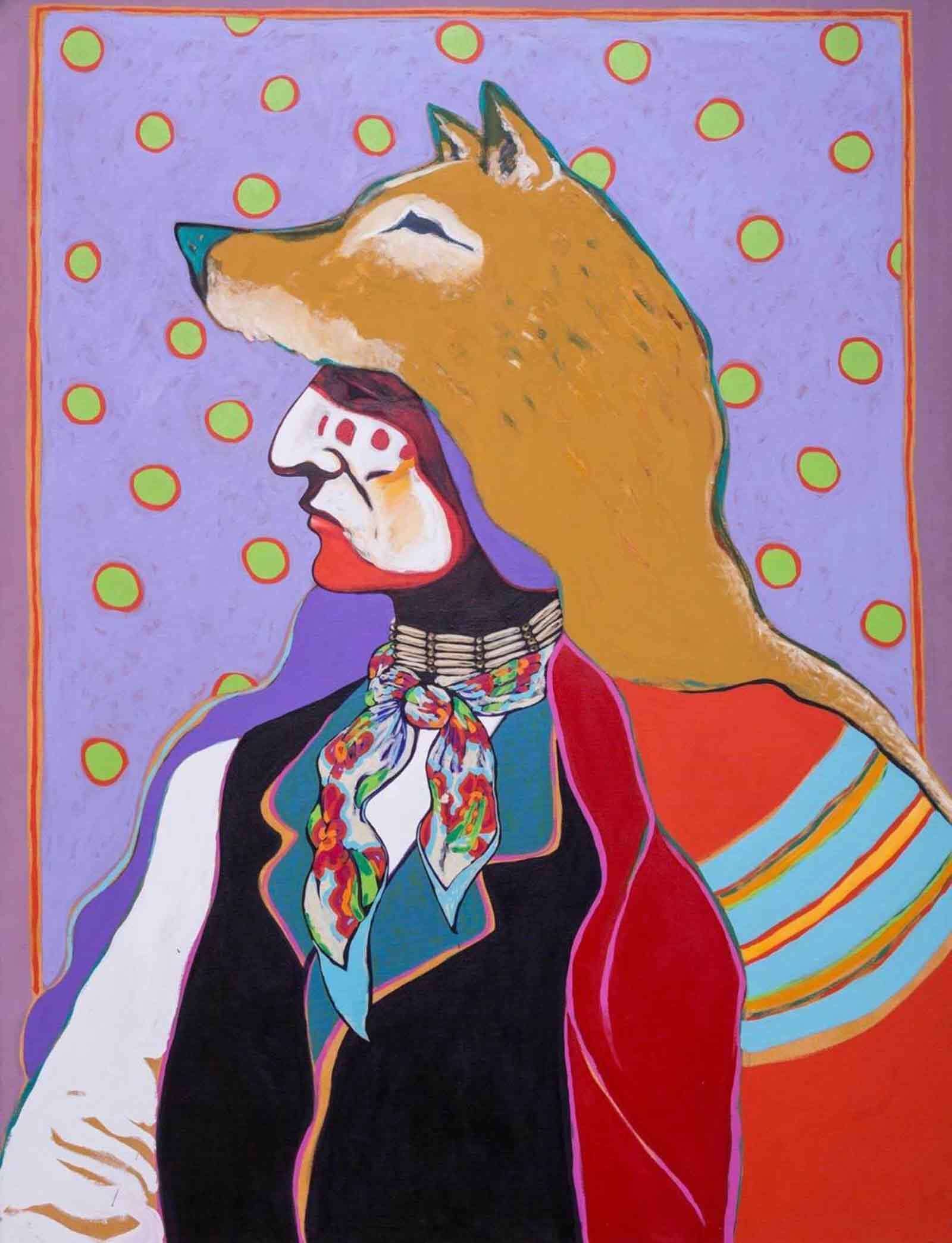
T.C. Cannon (1946–1978), a Native American artist of Kiowa and Caddo heritage, is widely regarded as a pivotal figure in the evolution of contemporary Indigenous art. His multidisciplinary practice—which included painting, poetry, music, and printmaking—challenged stereotypes, subverted mainstream representations of Native people, and infused Native identity with modernist and pop-cultural elements. Through his short yet prolific career, Cannon blended tradition with innovation, creating a visual and intellectual legacy that continues to resonate in American art.
Tommy Wayne (T.C.) Cannon was born on September 27, 1946, in Cyril, Oklahoma, into a Kiowa father and a Caddo mother. His upbringing in rural Oklahoma, steeped in Kiowa warrior traditions and Caddo cultural influences, played a foundational role in his artistic identity (Pennington 12). Cannon later studied at the Institute of American Indian Arts (IAIA) in Santa Fe, New Mexico, where he trained under Fritz Scholder and found his own creative voice. At IAIA, Cannon's encounters with both Native and modern art practices shaped his desire to break free from traditional boundaries and redefine Native American art (Smithsonian National Museum of the American Indian).
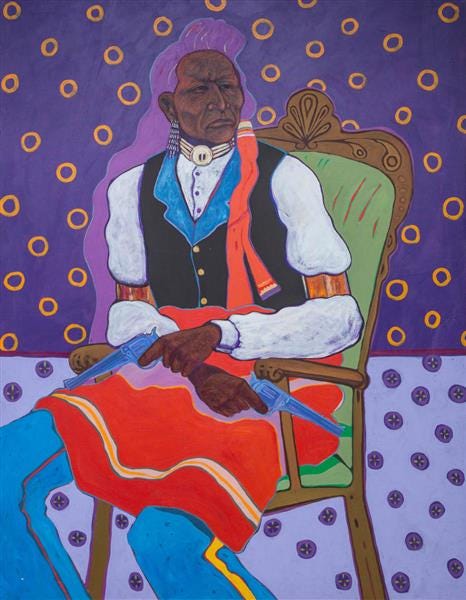
Cannon’s work is marked by its vibrant colors, expressionist forms, and complex engagement with historical and contemporary narratives. Unlike many of his contemporaries, Cannon consciously avoided romanticized or stereotypical depictions of Native life. Instead, his paintings offered critiques of assimilation, colonization, and the commodification of Indigenous culture. For example, his iconic work Two Guns Arikara (1974–77) portrays a Native man in ceremonial regalia seated on a modern chair against a minimal background, merging traditional identity with contemporary realities (Smithsonian National Museum of the American Indian).
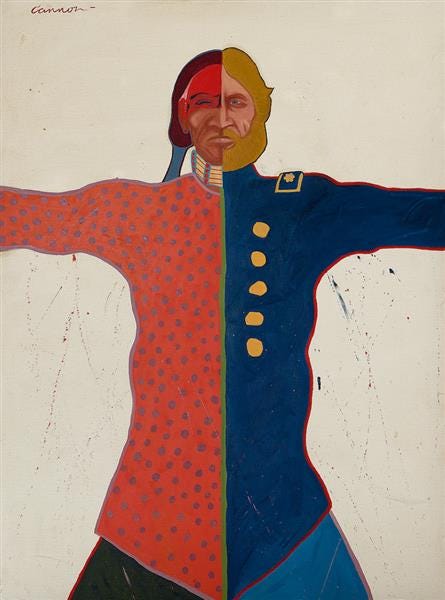
Cannon's time as a soldier in Vietnam deeply influenced his art. In pieces like Soldiers (1970), he explored themes of sacrifice, identity, and cultural paradoxes. This painting juxtaposes a Native figure in traditional dress with one in military uniform, symbolizing the conflicting roles many Native Americans navigated during service to a country with a fraught history of Indigenous oppression (Hyperallergic).
Cannon's poetry and song lyrics added a personal and reflective layer to his visual work. His writings often addressed themes of displacement, resilience, and the complexity of Native identity. Drawing inspiration from Bob Dylan and other cultural figures, Cannon combined humor, irony, and poignancy in his verses to further critique dominant narratives about Native people (Pennington 46).
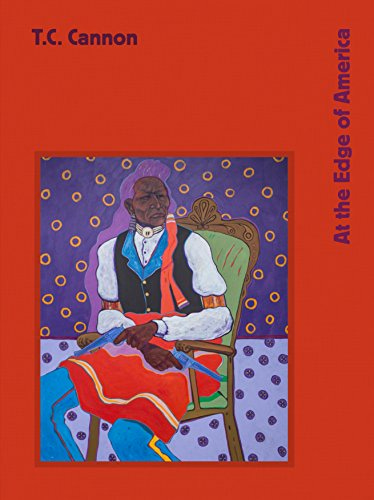
Despite his untimely death at 31 in 1978, T.C. Cannon left a profound impact on the art world. His groundbreaking work continues to challenge perceptions of Native art as static or bound by tradition. Retrospectives such as T.C. Cannon: At the Edge of America have celebrated his contributions, bringing his paintings, poetry, and music to new audiences (Smithsonian National Museum of the American Indian). Cannon’s ability to navigate between cultural heritage and contemporary artistic trends remains a defining feature of his legacy.
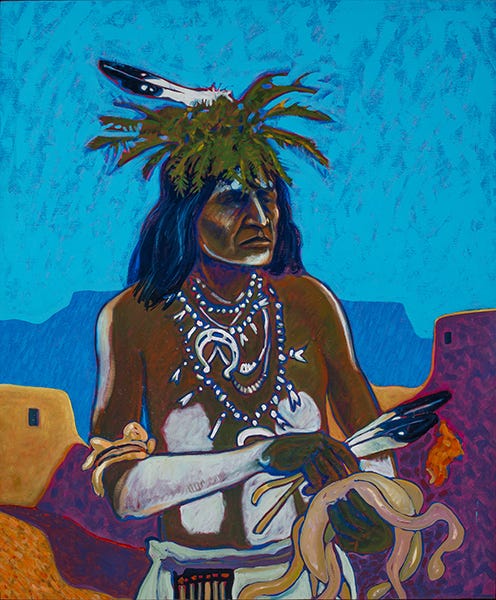
T.C. Cannon redefined Native American art by embracing modernism, critiquing stereotypes, and engaging deeply with issues of identity and representation. His art serves as a bridge between the past and present, challenging audiences to reconsider the narratives surrounding Indigenous peoples. As a trailblazer who expanded the possibilities of Native artistic expression, Cannon’s work endures as both a celebration of cultural pride and a critique of historical injustices.
References:
Pennington, Dean. T.C. Cannon: Life and Legacy. University of Oklahoma Press, 2017.
Smithsonian National Museum of the American Indian. T.C. Cannon: At the Edge of America. https://americanindian.si.edu/exhibitions/tccannon
Hyperallergic. How T.C. Cannon Redefined American Indian Identity. 2018. https://hyperallergic.com/
Am working on a piece about Arthur Rimbaud who only lived to 37, broke all the taboos of 100s of years of tradition while actually only writing until he was 20 years old. Sometimes it takes a short sharp shock to change the vernacular.